Physical Address
304 North Cardinal St.
Dorchester Center, MA 02124
Physical Address
304 North Cardinal St.
Dorchester Center, MA 02124

You’ve spent hours with the foam cannon, the two-bucket method, and premium shampoos to get that perfect shine. But did you know that the most critical moment for your vehicle’s finish isn’t the wash itself? It’s the drying.
Ironically, the final step—intended to leave your car spotless—is often where the most permanent damage occurs. If you aren’t careful, you aren’t just removing water; you are micro-scratching your way to a dull finish.
Most modern vehicles use a “base coat and clear coat” system. While the clear coat provides that deep gloss, it is surprisingly soft. From my experience, while the paint looks “hard,” the surface tension changes when wet, making the clear coat incredibly vulnerable to physical abrasion.
No matter how thoroughly you rinse, microscopic dust, grit, and environmental fallout can remain trapped on the surface. The moment you press a towel against the paint and move it, those particles act like tiny pieces of sandpaper. You aren’t just wiping; you are grinding debris into the finish.
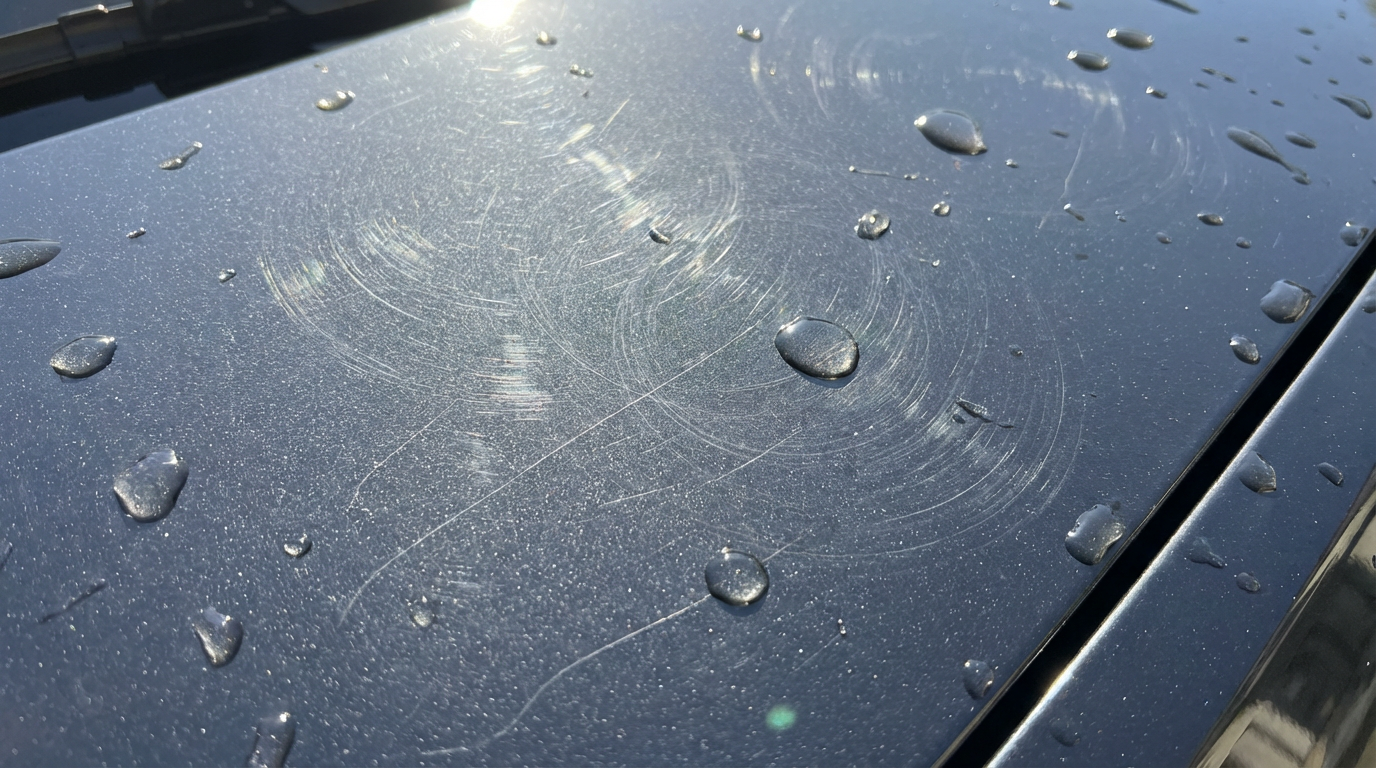
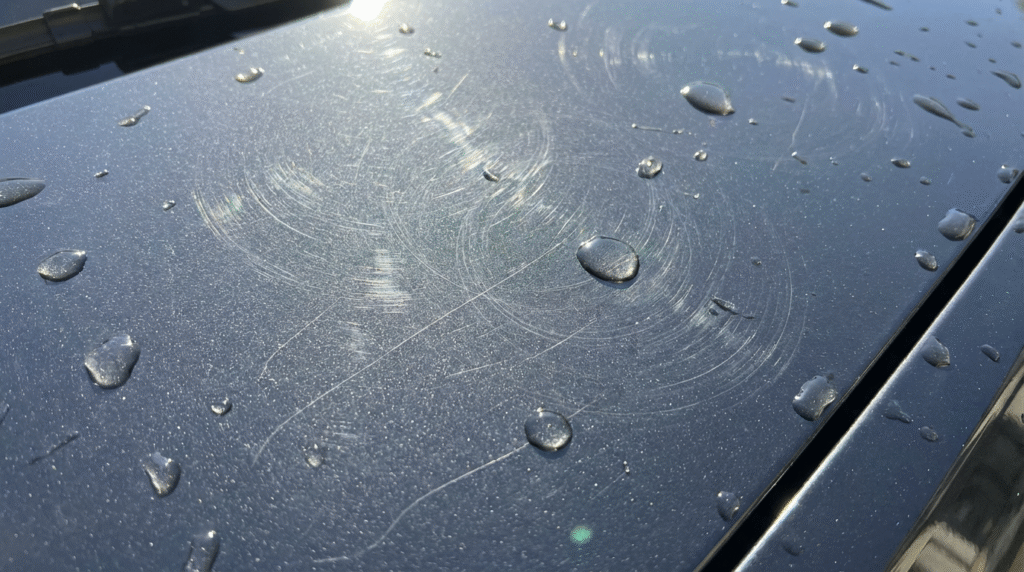
Water acts as a lubricant during the wash, but as the surface begins to dry, “stiction” (static friction) increases. This is why swirl marks—those annoying spider-web patterns visible in direct sunlight—often appear right after a drying session rather than from daily driving.
Many enthusiasts believe that a high-GSM (Grams per Square Meter) towel guarantees a scratch-free experience. In reality, even the softest towels only reduce the risk of damage; they do not eliminate it. Physical contact always carries a risk of “marring” the paint.
A single wipe might not leave a visible mark. However, car detailing is a game of accumulation. Over months of weekly washes, these microscopic “love marks” build up into visible swirl patterns that rob your paint of its depth and clarity..
If you see circular scratches on your hood, they didn’t come from the road. Most swirl marks are “man-made” during the washing and drying process. If you are touching your paint to dry it, you are likely the one causing them.
If you choose to let the car “air dry” naturally, you face a different enemy: Water Spots. Minerals like calcium and magnesium found in tap water stay behind as the water evaporates, leaving white, chalky rings that dim your paint’s gloss.
Beyond being ugly, these minerals are often alkaline. Over time, they can “etch” into the clear coat, creating permanent craters in the paint that require expensive professional polishing to fix.
Gravity is your enemy here. Water loves to hide in door handles, side mirrors, and trim lines. If not removed, this trapped water will “drip” out while you drive, creating unsightly streaks on your freshly cleaned panels.
The logic is simple: No touch, no friction, no scratches. By using high-velocity airflow instead of a towel, you remove the water without ever making physical contact with the clear coat. This is the gold standard for professional detailers.
Unlike a towel that becomes saturated and heavy, a constant stream of air never loses its effectiveness. It pushes water off the surface instantly, leaving a streak-free finish in half the time.
Airflow is the only way to effectively dry “impossible” areas:
🔹 Upgrade Your Detailing Game: The Power of Air At this stage, many car owners are moving away from the “laundry list” of towels and switching to high-powered air blowers designed specifically for car drying. > Unlike leaf blowers, these specialized tools use filtered air to ensure no dust is blown onto your wet paint. They allow you to dry the entire vehicle—including wheels and engine bays—without a single physical touch. It’s the ultimate way to reduce swirl marks while saving time, especially for those with ceramic coatings or dark-colored paint.
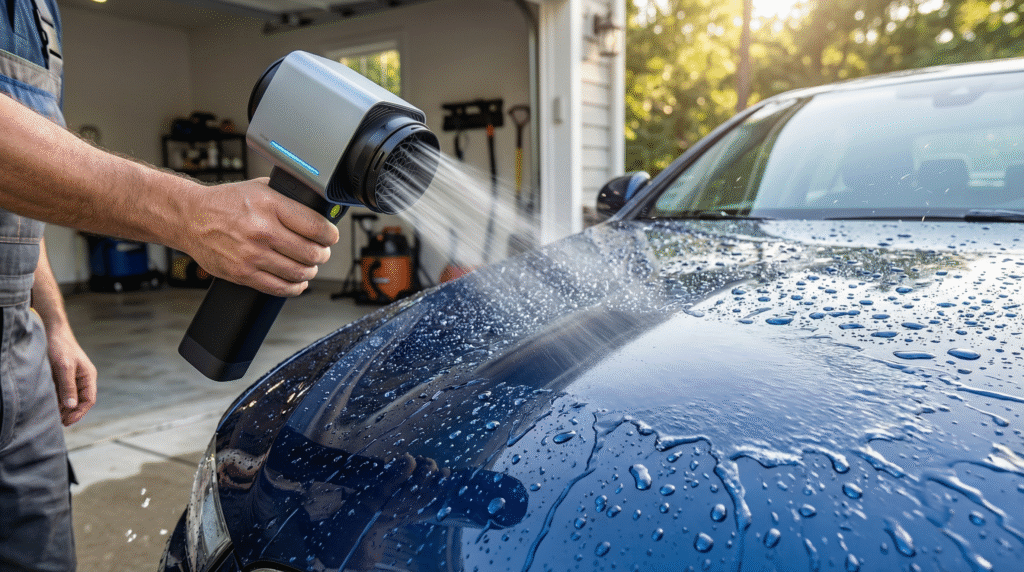
At this stage, many car owners are moving away from bulky leaf blowers and switching to high-powered, compact air blowers designed specifically for detailing.
Modern tools like the Booster Turbo Fan offer 100,000+ RPM brushless motors that fit in the palm of your hand. These tools allow you to dry the vehicle quickly without ever touching the paint, helping reduce swirl marks while saving significant time—a must-have for anyone with a ceramic-coated or dark-colored vehicle.
The secret to a “forever new” look is simple: The fewer times you touch the paint, the better your long-term results will be. Every touch is a risk.
Thorough Final Rinse: Use a “sheeting” method with low-pressure water to remove 50% of the standing water.
Airflow Removal: Use a car blower to clear water from the top down, focusing on gaps, mirrors, and wheels.
Minimal Finishing: If a few drops remain, use a clean, plush microfiber to gently “dab” (not wipe) the remaining spots.
While every car owner should consider this, it is essential for:
New Cars: Keep that factory finish for years.
Dark-Colored Vehicles: Black and navy paint show scratches instantly.
Ceramic Coated Cars: Airflow works incredibly well on hydrophobic surfaces.
Most paint damage doesn’t happen on the open road—it happens in your driveway. By rethinking your drying step and reducing physical contact, you can preserve your car’s gloss and avoid the “dullness” that plagues older vehicles.
Sometimes, the smartest upgrade isn’t washing harder—it’s drying smarter.
Ready to stop scratching your paint? [Check out our range of Professional Car Blowers] and see the difference a touchless dry can make.
[Shop Next-Gen Detailing Blowers Now]
🔹 Featured Tool: The Booster High-Velocity Car Dryer
If you’re serious about maintaining a swirl-free finish, the Booster TF64 is the ultimate game-changer. Engineered specifically for automotive enthusiasts, this isn’t just a blower—it’s a precision paint-protection tool.
Why It Outperforms Every Towel: Filtered Air Technology: Unlike standard leaf blowers that suck up lawn dust and blast it onto your wet car, our dryer uses a multi-stage filtration system to ensure only 100% clean air touches your paint.
Warm, Targeted Airflow: By heating the air slightly above ambient temperature, the [Product Name] evaporates moisture instantly, preventing water spots even in shaded or humid conditions.
Variable Speed Control: Blast water out of heavy-duty truck wheels or dial it down for delicate trim and badges.
Safe for All Coatings: Optimized for use on ceramic coatings, wax, and PPF (Paint Protection Film).
1. Is it okay to let my car air dry after a wash?
No. Air drying (letting the water evaporate on its own) is one of the leading causes of water spotting. As the water evaporates, it leaves behind concentrated mineral deposits that can etch into your clear coat, requiring professional polishing to remove.
2. Can I use a regular leaf blower to dry my car?
While a leaf blower is better than a bath towel, it’s not ideal. Leaf blowers are not filtered, meaning they can suck up sand, dust, and debris from your yard and shoot them directly at your wet paint at high speeds. A dedicated car drying blower ensures the air is clean and safe.
3. Will touchless drying remove wax or ceramic coatings?
Actually, it’s the opposite! Touchless drying extends the life of your wax or ceramic coating. Physical friction from towels eventually abrades and wears down these protective layers. By using air, you keep your protection intact for much longer.
4. What is the best way to dry a car without a blower?
If you don’t have an air blower yet, the safest manual method is the “Blotting Method.” Instead of dragging a microfiber towel across the paint, lay a large, clean drying towel flat over a wet panel and pat it gently to soak up the water. Lift it straight up and repeat. Never “scrub” the paint.
5. Why do I see swirls on my car even though I use “scratch-free” towels?
Swirl marks are often caused by contamination. If a tiny piece of grit gets caught in your towel, even the most expensive microfiber becomes a source of damage. This is why “contactless” methods are becoming the industry standard for high-end detailing.