Physical Address
304 North Cardinal St.
Dorchester Center, MA 02124
Physical Address
304 North Cardinal St.
Dorchester Center, MA 02124

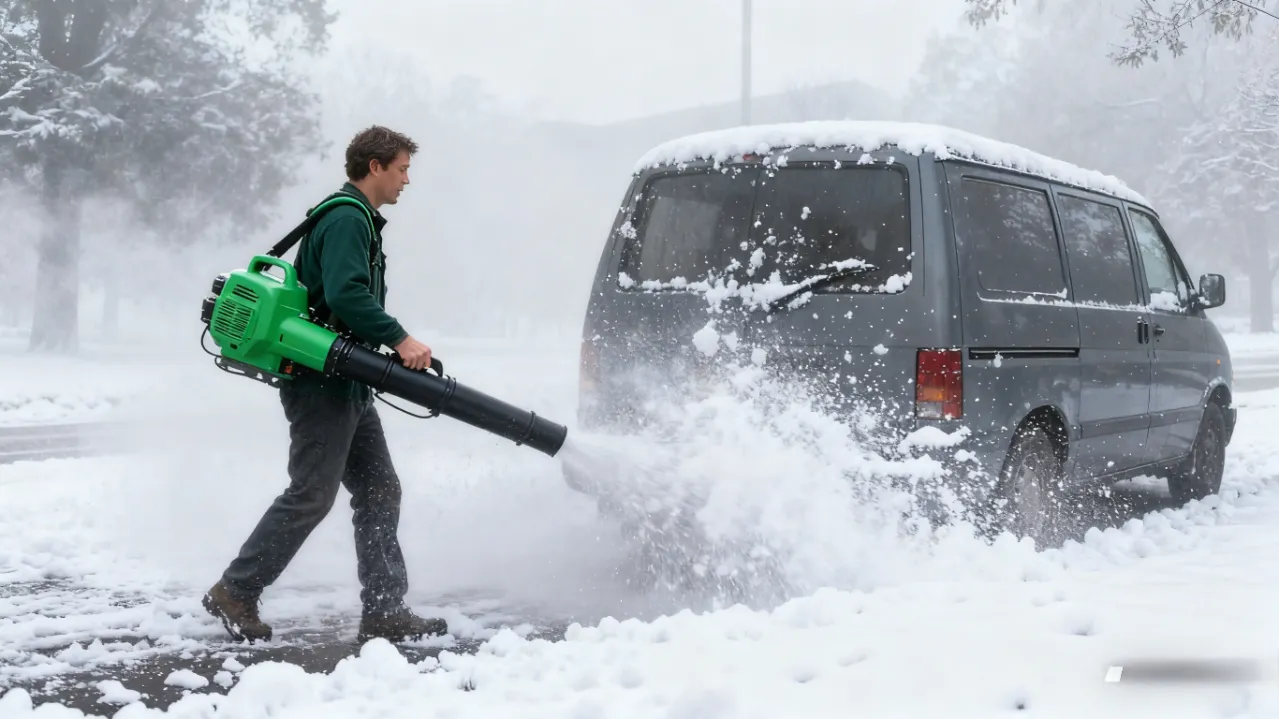
Leaf blower for snow. Let’s be honest: nobody likes standing in the freezing cold at 7 AM, frantically hacking away at a snow-covered windshield with a plastic scraper. Not only is it miserable, but every time you drag a brush across your car’s paint, you risk creating “swirl marks” and microscopic scratches.
There is a better way, and it’s probably sitting in your garage right now. Using a leaf blower to remove snow is a favorite trick among professional auto detailers. It’s contactless, incredibly fast, and surprisingly fun.
But before you grab your blower and head out, you need to know the right technique. If the snow is too wet or your blower settings are wrong, you’ll just be wasting time. Here is your complete guide to mastering this hack.
The primary reason to use a leaf blower isn’t just speed—it’s paint preservation.
Traditional snow brushes act like sandpaper. When you push snow (which often contains dirt and grit) across your car’s clear coat, you are essentially grinding that dirt into the paint. A leaf blower uses a cushion of air to lift the snow off, meaning nothing touches your car but air.
However, the effectiveness comes down to physics. You need a blower that balances CFM (Cubic Feet per Minute) and MPH (Miles Per Hour). High MPH strips the snow loose, while high CFM moves the bulk of the pile.
This is the most critical “pain point” usually overlooked. A leaf blower is not a magic wand; it depends entirely on the moisture content of the snow.
The “Champagne” Powder: This is the ideal scenario. When the temperature is well below freezing (below 25°F / -4°C), the snow is light and dry. Even a modest cordless blower with 350 CFM can clear an entire SUV in under 60 seconds.
The Heavy Slush (Wet Snow): If the temperature hovers around freezing, the snow becomes heavy and wet. In this case, a standard 100 MPH blower will struggle. To move wet snow, you typically need a high-performance blower with at least 500+ CFM and a “Turbo” mode.
Pro Tip: If there is a layer of ice under the snow, the blower will remove the top layer of snow but will not remove the ice. You will still need to defrost your windows safely.
Follow this workflow to clear your vehicle efficiently without blowing snow back into your face or into the car’s internal components.
Before you step outside, check your gear.
Battery Temperature: If you use a cordless blower (like EGO or Milwaukee), do not leave the batteries in the cold garage. Lithium-ion performance drops drastically in freezing temps. Keep your batteries inside the house until the moment you need them.
Nozzle Selection: Use a flat nozzle or a concentrator tip if you have one. This increases the air velocity (MPH), acting like a knife to slice through the snowpack.
The “Test Fire”: Turn the blower on away from the car first to ensure no loose debris or gravel is stuck in the tube that could be shot at your paint.
Start from the top center of the roof and work your way down. This prevents you from blowing snow onto areas you’ve already cleaned.
The Roof: Aim down the center and blow outward toward the sides.
Windshield & Wipers: This is a huge time saver. The air blasts snow out of the wiper crevices where brushes can’t reach, preventing the wipers from freezing to the glass.
Side Mirrors: A quick blast clears them instantly without knocking the mirror alignment.
Door Handles: Blowing snow out of the handles prevents them from freezing shut later.
While safer than a brush, using a power tool around a vehicle requires caution.
Avoid the Air Intake: Be very careful around the front grill. Do not blow high-pressure snow directly into the engine’s air intake or radiator, as this can pack the snow tight and cause overheating or airflow issues once the engine starts.
Watch Your Surroundings: Don’t be the neighbor who blows snow onto someone else’s freshly shoveled driveway. Be mindful of wind direction so you don’t end up covered in a “snow cloud” yourself.
Hearing Protection: Even electric blowers can be loud. If you are in a garage or carport, the sound echoes. Wear ear protection.
A: No. As long as the plastic nozzle of the blower does not physically hit the car, it is the safest method possible because it is contactless. It prevents the swirl marks caused by bristles.
A: For cars, cordless is superior. Gas blowers can be hard to start in freezing temps and emit exhaust fumes, which is dangerous if you are in a semi-enclosed carport. Cordless blowers are “grab-and-go,” provided you kept the battery warm.
A: It is difficult. If the snow is heavy slush, a leaf blower might not generate enough force to move it effectively. In these cases, a foam snow broom (external link example) is a safer alternative to a bristle brush.
A: Most quality tools are built to withstand the cold, but check your manufacturer’s manual. For example, brands like Milwaukee or Ryobi often have specific operating temperature ranges for their batteries. (Source: Milwaukee Tool Battery Safety)
If you already own a leaf blower, bring your battery inside tonight so it’s warm and ready for the morning rush. If you don’t have one, look for a cordless model with at least 450 CFM—this is the “sweet spot” spec that makes snow removal actually effortless.
Reference Links :https://leafblowerspro.com/how-to-use-leaf-blower-for-snow-on-car/