Physical Address
304 North Cardinal St.
Dorchester Center, MA 02124
Physical Address
304 North Cardinal St.
Dorchester Center, MA 02124

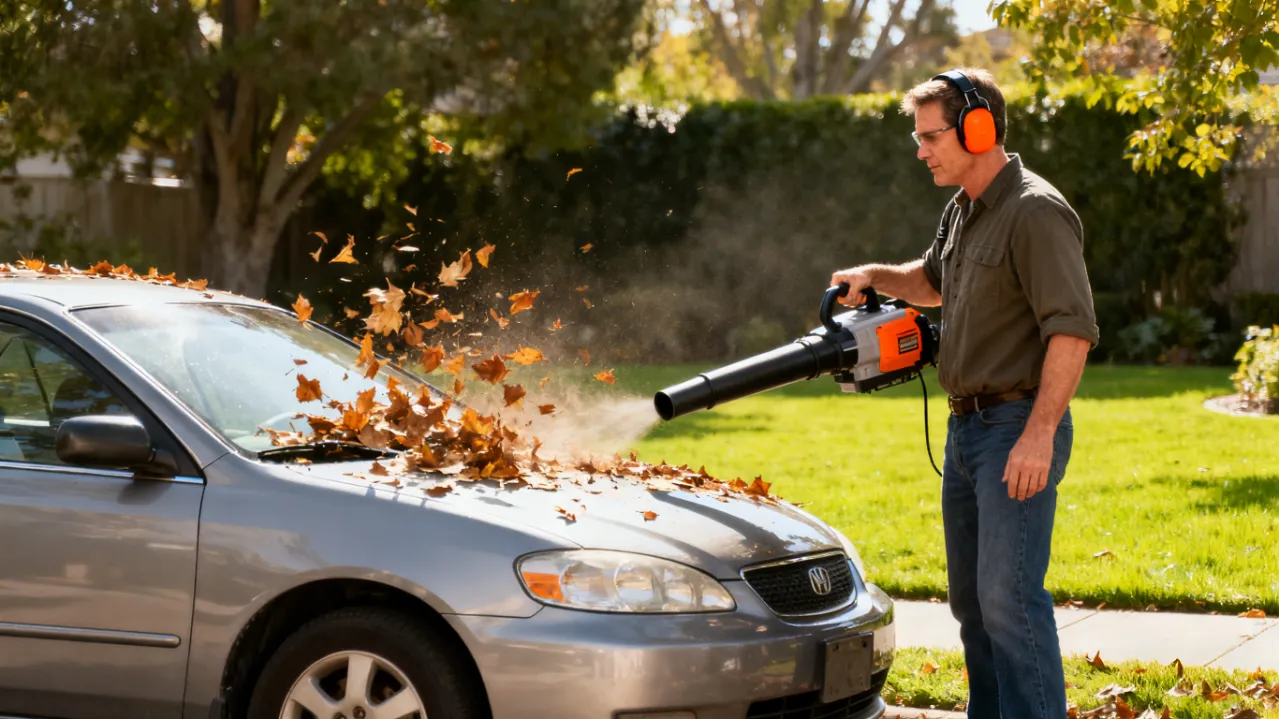
Let’s be honest: drying your vehicle is usually the most tedious part of the wash process. You wring out soggy towels, worry about scratches, and water still drips from the mirrors. But there is a better way.
Finding the best leaf blower for car drying doesn’t just speed up your detailing routine; it turns a chore into a breeze. And the best part? The right tool doubles as a workhorse for your yard.
For years, professional detailers have kept this secret. By choosing a leaf blower for car drying and leaf cleanup, you aren’t just buying a garden tool—you are upgrading to a professional, touchless car wash standard.
It might seem odd to point a garden tool at your prized vehicle, but the physics makes perfect sense. Whether you are moving a pile of wet oak leaves or blasting water droplets off a ceramic-coated hood, the goal is the same: moving mass with air.
However, the “magic” lies in how the air is delivered. A leaf blower doesn’t heat the air like a hair dryer; it uses high-volume air displacement. When you wax or coat your car, water wants to bead up. A leaf blower capitalizes on this by “sheering” the water off the surface faster than gravity can pull it down.
Think of it as a 2-for-1 investment. Instead of buying a dedicated car dryer (which can cost upwards of $300 and does nothing for your lawn), a quality leaf blower handles your driveway debris and your detailing needs.
If you are still on the fence about ditching your drying towel (chamois), consider this: friction is the enemy of paint.
Every time you touch your car with a towel—even a high-quality microfiber one—you risk dragging microscopic dust particles across the clear coat. This is where those annoying “swirl marks” come from. A leaf blower offers a 100% touchless drying method. No contact means no scratches
We’ve all been there. You spend 20 minutes drying the car, it looks perfect, and then you drive away. Suddenly, water trapped in the door handles, front grilles, and side mirrors comes streaming out, leaving ugly mineral streaks down the side of your clean car. A leaf blower blasts water out of those tight crevices that a towel simply cannot reach.
Drying a large truck or SUV by hand can take 15 to 20 minutes and multiple towels. With a powerful blower, you can get the car 90% dry in about 5 minutes without wringing out a single rag.
Using the machine is easy, but the technique for your car is different from your lawn. Here is the pro-way to handle the switch.
The “Clean Air” Rule
Before you point that blower at your car, make sure you haven’t just used it in a dusty environment.
Pro Tip: If you just finished the lawn, blow air into open space for 10 seconds to clear out any dust sitting in the tube. You don’t want to sandblast your paint.
Technique: The Top-Down Chase
Don’t just aim randomly. Start at the center of the roof. Push the water towards the windshield and the back window. Work your way down to the hood and trunk, and finally the sides. You are “chasing” the water to the ground.
Watch Your Nozzle
This is the only risk. The hard plastic tip of a blower can scratch paint if you bump into it. Keep a safe distance (about 6-12 inches). If you want to get closer, consider buying a rubberized nozzle tip or a “stubby” nozzle attachment specifically made for car drying.
Not every blower is safe for your car. If you grab that old, oily gas blower from the shed, you’re going to have a bad time. Here is what you need to look for:
Never use a gas-powered blower on your car. The exhaust fumes contain unburnt fuel and oil, which will spray a fine, greasy film all over your freshly washed vehicle.
The Pick: Go for a Lithium-Ion cordless model (40V or higher). They are lightweight, maneuverable, and clean.
Marketing often hypes up MPH (Speed), which is great for wet leaves. But for drying cars, you want CFM (Cubic Feet per Minute). High CFM means a wider, larger volume of air that dries larger panels faster. Look for a unit with at least 450+ CFM.
You need full power for the roof and hood, but around delicate trim pieces, loose weather stripping, or side mirrors, it’s nice to be able to dial the power back slightly.
A: It will, but it takes longer. Air drying works best on cars with a hydrophobic layer (wax, sealant, or ceramic coating) because the water already wants to bead up and roll off. If your water looks “flat” on the paint, the blower will struggle to move it
A: Generally, no. This is why it’s critical to keep your blower stored in a clean place. However, the air speed is so high that dust rarely settles in the tube.
A: Technically, yes. But Shop-Vacs are clunky, the hoses are often dirty from vacuuming car interiors, and maneuvering a canister vacuum around a wet car is a hassle compared to a handheld blower.
If you want to dive deeper into the specs or learn more about touchless detailing, check out these trusted sources:
For unbias tool reviews: See the Consumer Reports Guide to Leaf Blowers to find a model with high CFM ratings.
For detailing techniques: The Autogeek Auto Detailing Forum has endless discussions on the best drying methods used by pros.
Understanding Paint Care: Read The Drive’s Guide to Car Paint Maintenance to understand why minimizing contact is key to longevity.
Next Step: Are you tired of wringing out towels? Are you tired of wringing out towels? Browse our top picks for the best leaf blower for car drying and yard work, and change your wash routine forever.
Reference Link : https://leafblowerspro.com/leaf-blower-for-car-drying-guide/